How to License Surface Pattern Designs: The Business Side the Courses Skip
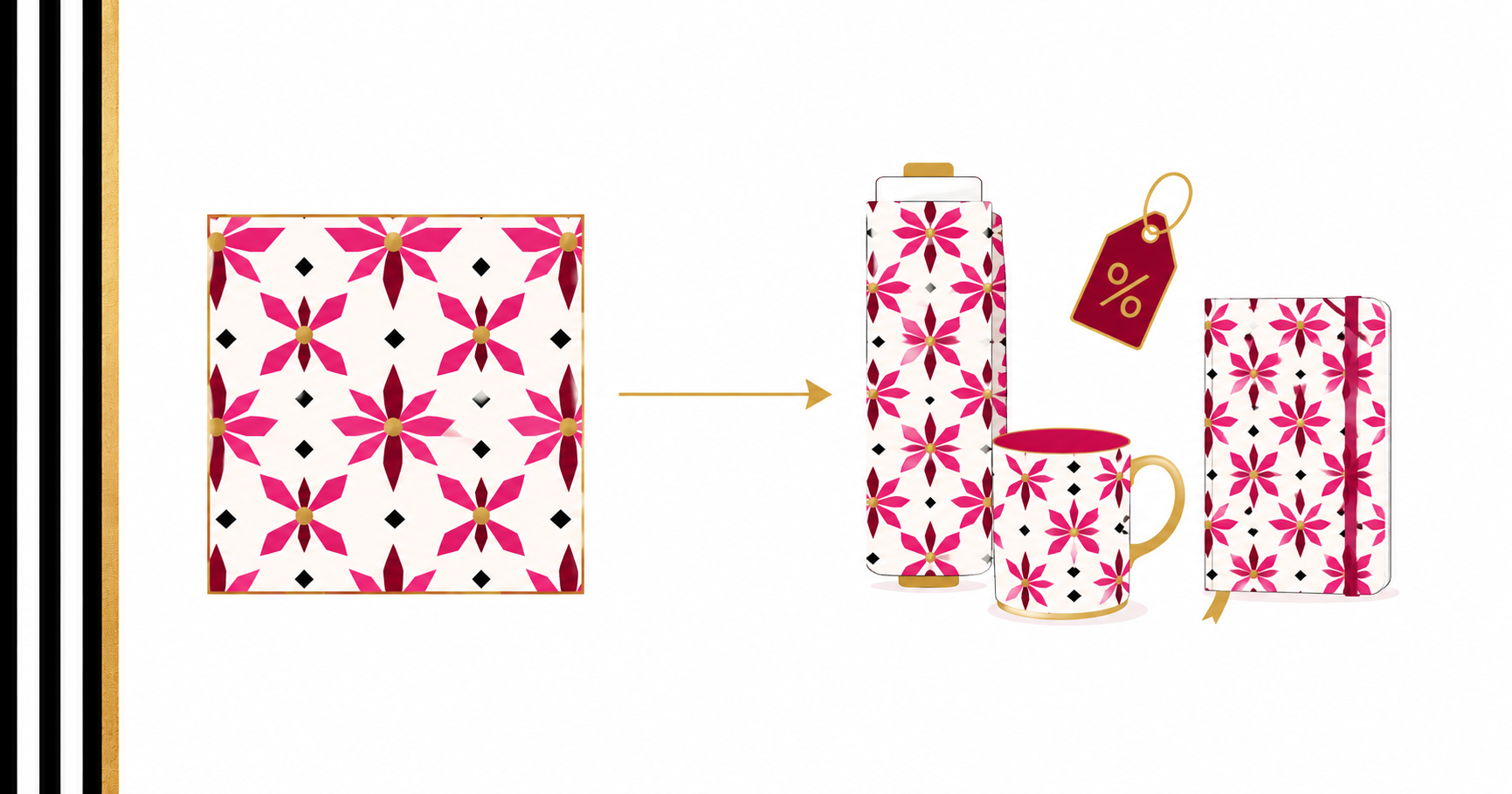
You can design a beautiful repeat. You can build a collection, set up a portfolio, and make work a brand would genuinely want. Nobody taught you what happens next.
The popular surface pattern design courses are brilliant at the artwork. They stop at the edge of the business. So when a company finally emails to say they love your work and want to use it, you are reading the contract for the first time with no idea whether the deal is good, bad, or a quiet rights grab.
This is the part they skip. How to license surface pattern designs as a commercial transaction, not just a creative one. What licensing actually means, the deal structures you will be offered, what royalties really pay, and the contract terms that decide whether a deal builds your business or quietly costs you.
I am not a lawyer, and nothing here is legal advice. Get any contract reviewed before you sign. But I have spent twenty-five years in commercial operations, and the licensing decisions below are business decisions before they are legal ones. This is how to think about them clearly.
What licensing actually means (and what it does not)
Licensing is not selling your design. It is renting it.
When you license a pattern, you keep the copyright. You grant a company permission to use that design, on agreed products, for an agreed time, in an agreed place, in exchange for money. You still own the artwork. They have bought the right to use it within the lines of the deal.
This is the part most designers get wrong, because it sounds like the opposite of the other ways to earn from a pattern:
Print-on-demand (Spoonflower, Society6, Redbubble): you upload, the platform sells products, you take a small royalty. Low effort, low control, low pay per sale.
Work-for-hire or a buyout: you sell the design outright. They own it forever. You get paid once and never again, and you cannot reuse it.
Licensing: you keep ownership and earn from agreed usage, often again and again.
Surface pattern design licensing sits in the middle, and it is the route with the best long-term economics for a designer with a real body of work. You build the design once and it can earn across multiple deals over years, as long as you do not accidentally sign those rights away.
The three deal structures you will be offered
Almost every licensing offer is one of three shapes. Know which one you are looking at before you respond.
1. Flat fee. A one-off payment for the right to use your design. Clean and simple. You get paid once, the company uses the design within the agreed terms, and that is the deal. The risk is scope. A small flat fee is fine for a limited use. The same small fee for broad, long, exclusive use is a bad trade, because you have given up everything that design could have earned elsewhere.
2. Royalty. A percentage of sales, paid over time. This is the structure designers dream about, because one strong design on a product that sells well can pay for years. The catch is that your income now depends entirely on the company's sales and their honesty in reporting them. A generous royalty on a product nobody buys is worth nothing.
3. Advance against royalty. A payment upfront that is then recouped from your royalties before ongoing payments begin. You get money on signing, which de-risks the deal, and you keep earning once the advance has earned out. For a designer building a business in the cracks of a busy life, this is often the strongest structure, because it pays you something now and something later.
What royalties actually look like
Here is where honest numbers matter, because the fantasy version of licensing has cost a lot of designers a lot of good decisions.
Royalty rates in art and pattern licensing commonly land somewhere around five to ten percent. The exact figure varies by product category, by company, and by how established you are. That percentage is usually calculated on the wholesale price, not the retail price the customer pays.
That distinction is everything. Ten percent of a wholesale price that is half the retail price is a much smaller number than it first sounds. A design on a product that retails at twenty pounds might earn you well under a pound per unit sold. Licensing pays through volume and longevity, not through a fat margin on each sale.
Flat fees vary even more widely, from modest sums for limited use to several thousand for a broad deal with a serious brand. US deals are frequently quoted in dollars, which is worth checking before you celebrate.
None of this makes licensing a bad route. It makes it a numbers route. Treat every offer as a sum to model, not a compliment to accept.
The contract terms that decide if a deal is good or bad
A licensing deal lives or dies on a handful of terms. These are the ones to read closely, every time.
Exclusivity. Exclusive means only that company can use the design. Non-exclusive means you can license it elsewhere too. Exclusive is not automatically bad, but it should be paid for and tightly scoped. Exclusive across all products, all territories, forever, for a small flat fee is the worst trade in licensing.
Term. How long the deal lasts. A defined term with an end date is healthy. "In perpetuity" means forever, and forever is rarely worth what they are paying.
Territory. Where they can sell. A UK-only deal leaves the rest of the world open to you. A worldwide deal does not, so it should pay accordingly.
Product categories. Which products the design can go on. Tight categories protect your ability to license the same design elsewhere. Broad or open categories close those doors.
Reversion. Whether the rights return to you when the term ends. They should. A deal where rights never come back is a buyout dressed up as a licence.
Minimum guarantee or advance. A floor on what you will earn regardless of sales. This protects you when a royalty deal underperforms.
If an offer asks for exclusive, worldwide, all-category, perpetual rights in exchange for a single flat fee, that is not a licence. That is a buyout, and it should be priced like one, or declined.
How to tell a good deal from a bad one
Strip away the excitement of being wanted and ask three questions.
First, what am I actually giving up? Map the exclusivity, term, territory, and categories. The more you grant, the more the design is worth, and the more they should pay.
Second, do the rights come back to me? If the answer is no and the money is not life-changing, it is usually a no.
Third, what does it realistically pay? Model the royalty against honest sales expectations, or weigh the flat fee against what those rights could earn elsewhere over the same period.
A good deal is clearly scoped, fairly paid for what it takes, and returns your rights at the end. A bad deal is broad, vague, permanent, and underpaid. Revenue is feedback. Run the numbers before your feelings run the decision.
How to actually land a licensing deal
None of the above matters if no brand ever sees your work. This is the part designers most want to skip, and it is the part that decides whether licensing is a real income route for you or a someday idea.
Licensing is an outreach business. The designers who license consistently are not waiting to be discovered. They have a portfolio of cohesive collections, not a scattered grid of single designs, and they make targeted approaches to the art directors and brands whose products their work would suit.
That means three things, in order:
Build collections, not one-offs. Brands license a coordinated story, a hero print with supporting patterns and a tight palette. Reframe your portfolio around collections that a buyer can picture on a product range.
Make a target list. The specific brands whose aesthetic matches yours. Not "anyone." A named, researched list of companies that already sell products your patterns belong on.
Reach out, badly at first. One clear, short message to one art director. Then another. Ready is built by pitching a few times and then less badly. The folder of finished designs earns nothing while you wait.
Pick one of those three to work on this month. Just one. If your portfolio is single designs, spend the month building one collection. If you have collections, spend it building the target list. If you have the list, send the messages.
Your move this week
Licensing your surface pattern designs is a business skill, and like every business skill it rewards one focused decision over a folder of intentions. Choose the single weakest link in your licensing setup right now, the portfolio, the target list, or the outreach, and give it your attention for the next four weeks.
The Anti-Spiral Monthly Planner is built for exactly this. One focus. Ten numbers. An honest look at what you avoided and why. Download the Monthly Planner here, free, and put your one licensing focus at the top of the page this weekend.
You already know how to make the work. Now you know how the deal works too. That is the gap the design courses leave, and it is the gap that pays.
Not sure which pattern keeps stalling you? Take the Anti-Spiral Audit.
By this time next month, something will have moved. Make sure it is the right thing.
Stop circling. Start building.
Jodie